Makkah Notebook (2)
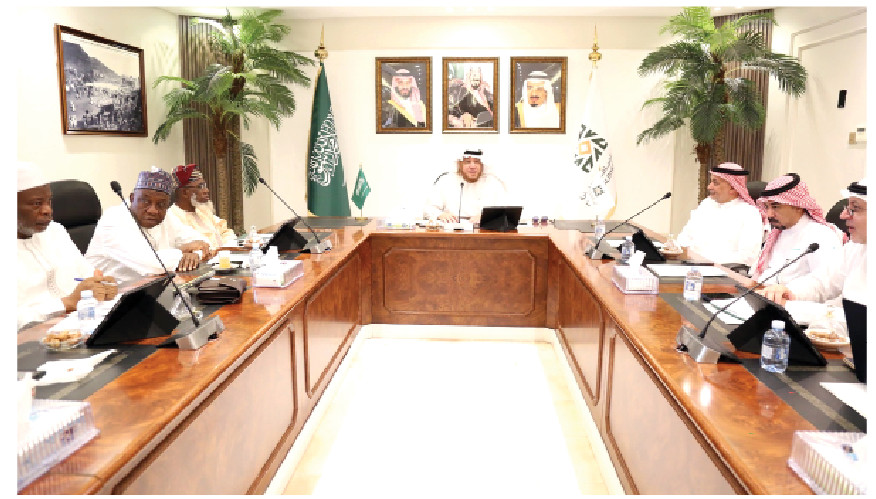
Last week, I recounted how the leadership of Nigerian tour operators travelled to Makkah to select the Saudi service providers for Hajj 2027, and how, on Saturday, 26 September, we met Jabal Omar Development Company and Manasek Mashaer Company. I had taken the story to the point where two providers had been seen and two remained. We resume with Sunday’s visits.
Sunday, 27 September: Ithraa Al-Jood and Rawaf Mina
We began at Ithraa Al-Jood, our appointment fixed for eleven o’clock, and were warmly received by the Chief Executive, Dr Adnan, and their consultant, Mr Zuheir Banjabi. To those of us who have spent more than twenty years in this field, both are household names. The meeting felt less like a negotiation than a class reunion — old colleagues meeting again after years, men with whom one has sometimes agreed and sometimes quarrelled, but with whom friendship endures. Much of their team is the old Mu’assasah we knew before the new regulations reshaped it into private companies. Mr Zuheir, whose experience in the Mashaa’ir is almost without parallel, serves as consultant to Ithraa Holding, the conglomerate that unites Ithraa’s divisions across the Hajj operation.
With audiovisual support, they walked us through their services in the Mashaa’ir, their meals in open buffet or takeaway packs, and what their D-tent pilgrims received in the past Hajj. On VIP packages they were expansive: superb accommodation in Zone 5, including tents of the standard of the Kidana building, and villas with executive tents and suites. The videos were impressive, and the location is no obstacle, for the train station is but a ten-minute walk away; pilgrims may travel to the Jamarat by train and return the same way. That prospect is genuinely alluring, because our enduring bane has been the long trek back from the Jamarat under the one-way traffic arrangement the authorities maintain to prevent stampedes. I accordingly requested a physical inspection of the facility, which was granted, and four o’clock fixed for the visit.
More importantly, Ithraa addressed the concern that had exercised us since Saturday: the problem of two service providers. Whereas Mr Ahmad had told us that the company we sign with may serve only in ground services while another handles the camps — an arrangement whose taste was sour in Hajj 2026 — Ithraa told us the difficulty is overcome within their group, one subsidiary providing ground services and another camp services. They offered a ground-services package: Package 1 at SAR2,200 and Package 3 at SAR1,400, inclusive of taxes, with the candid caveat that the prices “are subject to negotiation and may be adjusted by mutual agreement,” and that any new government fees or regulatory changes may alter them accordingly.
The discussion was frank. Those who had grievances against Ithraa in the past spoke plainly and urged reform, and our team pressed the case for a Nigerian catering company to be part of the camp feeding arrangement, so that our pilgrims may enjoy the authentic taste and cuisine they cherish. On intercity transport, we raised the refusal of some transport companies to carry small groups unless twenty-five to thirty pilgrims travel together; Ithraa undertook to arrange a meeting with the transport company and advised us to furnish definite arrival and departure dates early, offering the train as an option for small numbers. After Asr, we inspected the Zone 5 facility as agreed. I confess I had expected a standard akin to Ithraa’s fine building in Arafah — modern, centrally air-conditioned, with modern conveniences and dependable lighting and water. It was not. I was left wondering what informed Dr Adnan’s answer that its price equalled that of the Kidana building; the two are not of the same standard. I take some comfort that both Manasek and Ithraa have said they can secure the Kidana building if we insist upon it for our VIP services — a matter for our next engagement. The train station they showed us was real enough, though we must not forget that at the height of the season the place will not be as free as it appears today, and pilgrim traffic may deny the easy access vaunted in the meeting.
Our final visit was to Rawaf Mina for Pilgrims Services Company, where we were again at ease, for we were not newcomers to their premises. They spoke of new currents in the Hajj ecosystem and of a comprehensive package covering housing in Madinah and Makkah, transport, catering and the Mashaa’ir, with the air ticket the only notable omission — perhaps to be included in future. They reminded us of our long relationship and of their aim to solve problems at all times, asking us to bear in mind their situation, serving pilgrims of many nationalities at once, where inadvertent shortcomings are bound to arise. Rawaf, they said, has the largest IT system in the industry and deals in Umrah and transport besides; it will soon have its own catering division. Only nine companies have been designated by the Ministry of Hajj and Umrah for camp operations, and Rawaf Mina is among them, so that in Hajj 2027 it can serve us in both ground and camp services — as an SPC and as a Camp Operator.
We put to them the difficulties our pilgrims faced at Rawaf’s tents last Hajj, including the Kidana building, where pilgrims were assigned tents already occupied by others. I recounted my own embarrassment: many pilgrims registered under my company were politicians, and the 2026 Hajj fell within their party’s primary elections. Although they had paid in full, most could not travel; they arranged for their spaces to be taken by others. I informed Rawaf through no less an authority than the Chairman himself, who asked me to submit a list of the affected pilgrims with their Rawaf visa numbers, alongside a list of the replacement pilgrims with non-Rawaf visa numbers, which I did by WhatsApp as instructed — only for those pilgrims to be denied entry to the Kidana building. The Chairman apologised, explaining that they had lately learned from the Ministry that pilgrims must stay in tents belonging to the companies that processed their visas, entry points being fitted with sensors that read each Nusuk card and report intrusions to the central system, whereupon the Ministry penalises the offending company. He assured us such mistakes would be avoided in future. They have now served Nigerian pilgrims for two pilgrimages, he noted, adding that some of our pilgrims cause needless disturbance to others and that some operators smuggle in pilgrims who have not paid for the Kidana building. I suggested that, knowing the names behind such companies, they might discreetly report them to both the Ministry and NAHCON for sanction, without endangering the lead company under which they operate. The Chairman agreed to work with Nigerian operators on a Kidana Committee to scrutinise entry to the building during Hajj.
Further complaints followed — poor distribution of Nusuk cards, feeding, overcrowded rooms, and mosque space that seemed insufficient during the stay in Mina. Rawaf answered that they distributed more than 70,000 Nusuk cards to pilgrims worldwide but could not do so for Nigerian pilgrims because the pre-arrival information we enter in the system is often incorrect. The Nusuk card is requested from the Ministry but is highly controlled and issued by the Ministry of the Interior; it is no mere card, for it carries all a pilgrim’s information. For Nigeria to receive its cards like other countries, it must supply accurate information at the right time. On the need for urinals, barbering areas and cleaner toilets — ailments having been rife during Hajj 2026 — Rawaf promised to improve the toilets with modern facilities, urinals included.
Monday, 28 September: the house-cleaning meeting and the decision
What I have not yet told you is how the mission closed. On Monday, the day after the last visit to Ithraa — the movement having begun on Saturday — we convened at the same venue for a house-cleaning session before we dispersed to Nigeria. We did not dwell on ranking the best of the four. Rather, we agreed that Jabal Omar Development Company should be dropped. The people behind it did not show the commitment the other three did: they met our team at a neutral place, a hotel, and not their office, and only two officers attended. To this were joined the shortcomings I recorded earlier — three years out of Hajj service, a troubling uncertainty about basic figures, a rigid flat tariff, and an inability to serve in the Mashaa’ir, where camp services must be contracted to another. We therefore adopted the remaining three. Since the Ministry of Hajj and Umrah has not yet released the final unified rates, we resolved to defer the final selection until the rates are out, when we can negotiate further and make the ultimate choice of service provider.
That, in sum, is the outcome of our mission: a team sent to negotiate, not to ratify; a shortlist of four visited; one company dropped for want of commitment; three retained; and a final choice rightly deferred until the rates are published and the best bargain for our pilgrims can be struck. Running through it all — from the self-funded journey, through the recurrent danger of providers being foisted upon operators, to the discipline of a collective decision — is a single thread: the trust those we represent have placed upon our shoulders, and our accountability before Allah for how we discharge it.
I am not here preferring one company over another. I am stating what I saw and heard. The decision rests with our team and our leadership, and I trust they will exercise it with the fear of Allah. Let me end where our mission began: this is a sacred assignment, undertaken on behalf of pilgrims whose journey is an act of worship. It demands honesty, diligence, transparency and, above all, unity among us — for no interest, however powerful, should be allowed to profit from our division. May Allah guide us to what is right for our pilgrims, and may He reward every one of us who bore the burden of this errand for His sake alone.
to like, bookmark, and comment.
Comments
Join the conversation:
No comments yet. Be the first to share your thoughts.