Lagos Governorship Hopefuls Face Young Voters on Culture, Housing, Taxes and Child Welfare
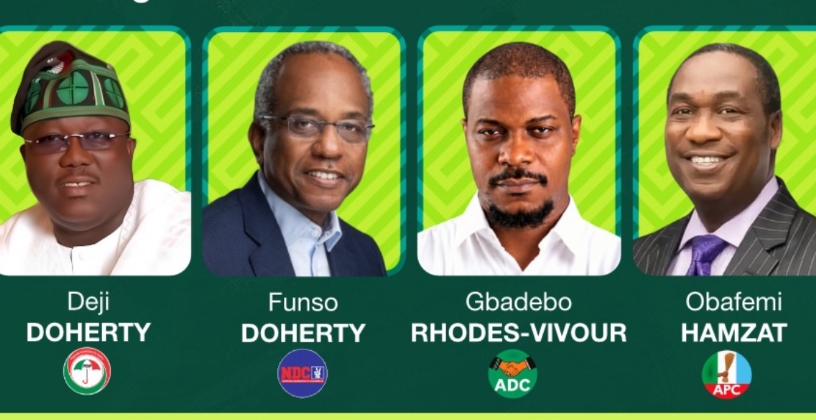
At a town hall in Lagos on Thursday, four governorship candidates fielded questions from millennial and Gen Z voters. The Platform Nigeria organised the session, which brought together contenders from different parties to respond to young residents of the state.
The participants were Gbadebo Rhodes-Vivour of the African Democratic Congress, Obafemi Hamzat of the All Progressives Congress, Funso Doherty of the Peoples Democratic Party and Deji Doherty of the National Democratic Congress.
Asked how he would safeguard Yoruba language and culture in Lagos, Rhodes-Vivour said the state is Yoruba land and pledged to intensify efforts to protect the people's language, culture and history. He began answering in English, but audience members cut in and urged him to respond in Yoruba. He told them he had come to discuss politics, yet went on to criticise how the Yoruba language is handled in schools.
He said that after more than two decades of APC rule, pupils who speak Yoruba in primary and secondary school are still told it is vernacular and are beaten and punished for it. He added that the matter should also be put to representatives of the Lagos State government who were at the meeting.
Rhodes-Vivour connected cultural preservation to wider concerns about education, healthcare and the cost of living, arguing that families would worry less about such matters if quality public services were available. He said it was essential that the culture be preserved. He promised to set up a ministry responsible for culture and said his administration would study Lagos' culture and history more deeply than is currently done.
During the 2023 governorship race, Rhodes-Vivour came under scrutiny over his Yoruba identity and his ability to speak the language, with his mixed Yoruba and Igbo heritage turning into a political issue. His remark in a Channels Television interview that he did not "think in Yoruba" attracted criticism at the time and fed a broader debate about his suitability to govern Lagos.
Hamzat pledged to eliminate levies on businesses that are unauthorised and cannot be traced, saying operators ought to know exactly what they owe. He said the state would join forces with federal and local authorities to harmonise taxes and charges and end multiple collections. Government's job, he said, is to make sure businesses start, survive and grow, and any levy that is unauthorised, unknown or untrackable would be scrapped, with no one allowed to stand at a junction collecting levies.
On waste management, Hamzat said the state would expand its capacity to collect and process waste rather than lean mainly on landfills. He said about 160 additional waste trucks were being brought in and transfer loading stations were being built, each able to handle roughly 2,500 tonnes of waste. Two material recovery facilities and a waste-to-energy plant at Agbara also form part of the plan, with the plant expected to process about 3,000 metric tonnes of waste.
He said the transfer loading stations at Solous and Agbara would be finished before the current administration leaves office, with more facilities planned for places including Badagry and Ikorodu. He said the two in Agbara and Solous should be completed before April.
Asked about his priorities for his first 100 days, Hamzat said child welfare would be a focus and that a dedicated agency would be created for children's wellbeing. The proposed Child Welfare Administration Agency, he said, would be carved out of the Ministry of Youth and Social Development and would ensure children are properly cared for. He said children in Lagos cannot be left roaming the streets and that everyone under 18 must either be in school or learning a trade. He noted that monitoring children in Lagos is hard because of the influx of people from other parts of the country, including those displaced by insecurity.
Deji Doherty of the PDP proposed affordable high-rise housing outside the Lagos metropolis, backed by efficient transport so residents can travel to work. He named Epe, Badagry and Kosofe as locations where better transport links and housing could be developed. He said his administration would consider buying family-owned properties for housing development, subject to negotiations with the owners. He said government would negotiate with property owners rather than force them to sell.
He said the aim was to build affordable housing in less crowded parts of the state while providing dependable transportation between those areas and the metropolitan centres. According to him, the main gap is that successive governments have failed to use revenue from land-related charges to develop enough housing and infrastructure. He argued that the Lagos government, as custodian of public land, should use revenue from land use charges and other levies to build roads and housing and ultimately become a major landlord in the state. He asked what government was doing with the charges it collects.
Funsho Doherty of the NDC promised to build a Lagos where no child is denied education or healthcare because their parents cannot pay. He said his vision rests on a social contract in which citizens pay taxes and contribute to the economy while government provides basic services and creates an enabling environment. He said Lagos has a strong obligation to deliver quality public services given the resources at its disposal.
Citing recent National Bureau of Statistics data, he said Lagos generates more internally generated revenue than 31 other states combined after excluding Delta, Rivers, Ogun, Enugu and the Federal Capital Territory. He said his administration would focus on ensuring that poverty does not stop children from accessing education or healthcare. He said his vision of Lagos is one where no child is left out of an education because their parents cannot afford it, and no child dies because their parent cannot afford drugs.
to like, bookmark, and comment.
Comments
Join the conversation:
No comments yet. Be the first to share your thoughts.