INEC Must Reconsider Aliu, Adeyemi–Showunmi
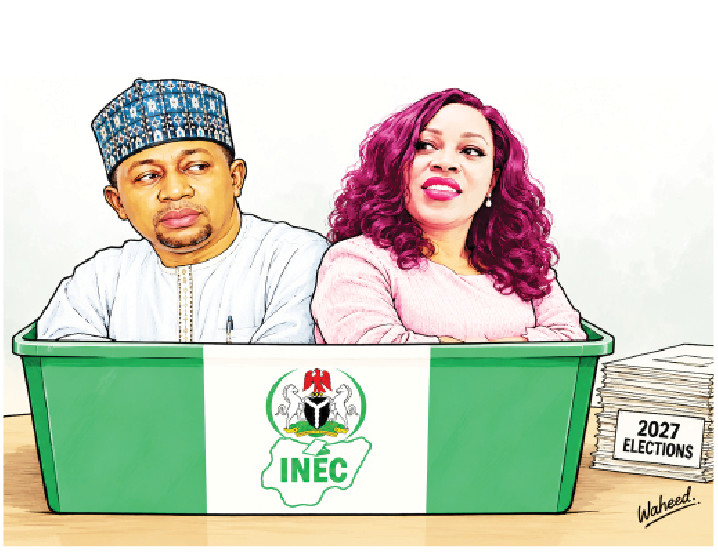
Are the controversies surrounding the appointment of Professor Mustapha Aliu as Independent National Electoral Commission (INEC) National Commissioner for the North West and the redeployment of Mrs Oluyemi Titilayo Adeyemi-Showunmi to Director of Electoral Operations warranted? The straightforward answer is yes.
Professor Aliu is related to Sokoto State Governor Ahmed Aliyu, who is also the All Progressives Congress (APC) candidate for governor in next year’s election. Adeyemi-Showunmi is the wife of Segun Showunmi, a spokesman for the APC presidential campaign.
Professor Aliu will represent the North West as one of the 13 members of the commission. The commission comprises a chairman and 12 National Commissioners and is responsible for INEC’s main policy formulation and decision-making. As a National Commissioner, he will help formulate operational policies, strategic plans and guidelines for elections and general administration.
He may also chair any of the standing and ad hoc committees covering logistics, voter education, legal matters, finance, ICT, and political party monitoring. Most importantly, he will supervise elections and the resident electoral commissioners in the seven North West states: Jigawa, Sokoto, Kebbi, Katsina, Kano, Zamfara, and Kaduna.
As Director of Electoral Operations, Mrs Adeyemi-Sowunmi will play a fundamental role in planning and implementing the deployment of election materials and in managing election personnel, among other critical responsibilities throughout the electoral process.
No defence
Of all the arguments advanced in this controversy, none is more feeble than the appeal to the 2023 Lagos results. Apologists claim that because the Labour Party’s Peter Obi defeated President Bola Tinubu in his political backyard while Mrs Adeyemi-Sowunmi served as INEC Administrative Secretary, her neutrality is thereby proven. This defence is entirely superficial.
This argument falls apart because it relies on a false equivalence. An administrative secretary lacks the structural authority of an operations director. This is true even in a minor organisation and is indisputable within a powerhouse like INEC. Professor Aliu’s appointment and Mrs. Adeyemi-Sowunmi’s redeployment are twin strategic moves. Both figures are highly politically exposed and bound by direct family ties to key players with vested interests in the 2027 elections.
Can we truly talk about electoral integrity when the referees are deeply embedded in the players’ dressing rooms? Consider the stark realities of our current system: a senior official is tasked with overseeing elections across seven states, including the very state where his younger brother is fighting for re-election. At the same time, we have an operations director married to a prominent spokesperson for the president and for the ruling party’s presidential candidate.
To suggest that these conflicts of interest do not matter is to ignore the bedrock of democracy: public trust. When the lines between neutral oversight and partisan loyalty are so profoundly blurred, institutional credibility evaporates, leaving the entire electoral process vulnerable to suspicion.
Justified concerns
I believe, like most Nigerians, that those raising concerns about possible bias are justified. Professor Aliu’s appointment is difficult to justify. He may be eminently qualified, but qualifications alone should not determine such a sensitive appointment. Other considerations, including his proximity to a governor seeking re-election and the likelihood of bias, do not appear to have been thoroughly examined. That is the challenge.
The ongoing controversy over these two appointments strikes at the heart of INEC’s perceived impartiality. If the electoral commission believes these concerns are baseless, it is in dangerous self-denial. Appointing an individual with such close ties to a sitting governor seeking re-election makes a mockery of neutrality. In an environment where trust is already fragile, no amount of reassurance can persuade the public that such a deeply conflicted appointment is fair.
There is nothing to suggest that INEC is unaware of Mrs Adeyemi-Showunmi’s background. Equally, there is nothing to suggest that President Tinubu, who appointed Professor Aliu, is unaware of his relationship with Governor Aliyu. Nor is there any indication that these two individuals are the only qualified candidates for the positions. Why should we be stuck with them despite genuine concerns about neutrality?
Professor Joash Amupitan needs no reminder that Nigerians are watching his every move. Already tainted by a controversial tweet alleging bias, he has faced intense public scrutiny since his appointment. Rather than projecting neutrality, the redeployment of Adeyemi-Sowunmi and the appointment of Aliu have fuelled scepticism, casting deep shadows over his promise of impartiality.
Waiting for credible poll
As the 2027 elections approach, INEC faces intense, justifiable scrutiny. Despite repeated assurances of credibility from its chairman, Professor Amupitan, the commission’s success hinges on one critical factor: absolute political neutrality. To deliver truly free, fair, and credible elections, INEC must ensure that its personnel are entirely non-partisan.
Indeed, recognising this fact, Section 14(2a) of the Third Schedule to the 1999 Nigerian Constitution provides for political neutrality, stating, inter alia, that “a member of the Independent National Electoral Commission shall be non-partisan and a person of unquestionable integrity.”
Nigeria’s quest for credible elections remains elusive, marked by a long and tortuous journey. The steady rise in tribunal petitions across successive cycles since 1999 serves as a stark reminder that the country’s democratic process is fundamentally flawed.
Elections in Nigeria are routinely rigged, and the electoral umpire, INEC, is often complicit. This partly explains why many Nigerians have lost faith in the electoral process. Election integrity matters deeply. In a country where public trust in institutions is low, flawed electoral processes have dangerous implications. They not only encourage voter apathy but also heighten the risk of post-election violence, as seen in the past.
Fundamentally, Professor Aliu’s appointment exposes a flaw in the process for appointing INEC leadership, which is clearly designed to favour the president and, by extension, the ruling party.
The Constitution vests the power of appointment in the president, subject to parliamentary approval. However, this system is profoundly flawed. It allows a partisan actor—the president—to appoint those who oversee elections in which the president or their party has a vested interest.
One thing is clear: the process lacks transparency. This undermines INEC’s credibility and impartiality, both of which are unacceptable in a democracy.
Way forward
Nigeria’s democratic future depends on sweeping electoral reform. At the heart of this fight is the process for appointing INEC officials. We must dismantle the current mechanism that prevents political interference and safeguards the integrity of our electoral management body.
A glaring conflict of interest fundamentally undermines our electoral integrity. We cannot expect presidents who are actively contesting elections or aggressively backing their party’s successors to appoint impartial umpires. Inevitably, they select individuals who align with their own political survival.
This toxic dynamic is mirrored at the state level. Governors exert undue influence over State Independent Electoral Commissions (SIECs), engineering landslide victories for the ruling parties in local government elections. True electoral independence is impossible when the contestants choose the referees.
Perhaps the time is ripe for Nigeria to consider appointing political party representatives to INEC’s leadership. Such a move would foster consensus among contestants and enhance transparency, thereby strengthening confidence in the electoral process.
I am of the considered opinion that involving political party leaders in INEC’s leadership will significantly boost voter turnout by fostering trust. When average voters see key party figures actively participating in the electoral process, it reassures them of the Commission’s impartiality and helps safeguard democratic integrity.
Kano And The Shut Grain Stores
The Kano State government’s decision to shut down some grain storage facilities in its Dawanau market for using pesticides to preserve beans is commendable. The use of chemicals to preserve food, a practice that is illegal due to their inherent dangers, has become rampant in Nigeria. Beyond shutting the stores, Kano needs to prosecute those responsible to serve as a deterrent.
to like, bookmark, and comment.
Comments
Join the conversation:
No comments yet. Be the first to share your thoughts.