Atiku decries hardship in Sokoto as Sanusi credits Tinubu with economic recovery
Add us on Google
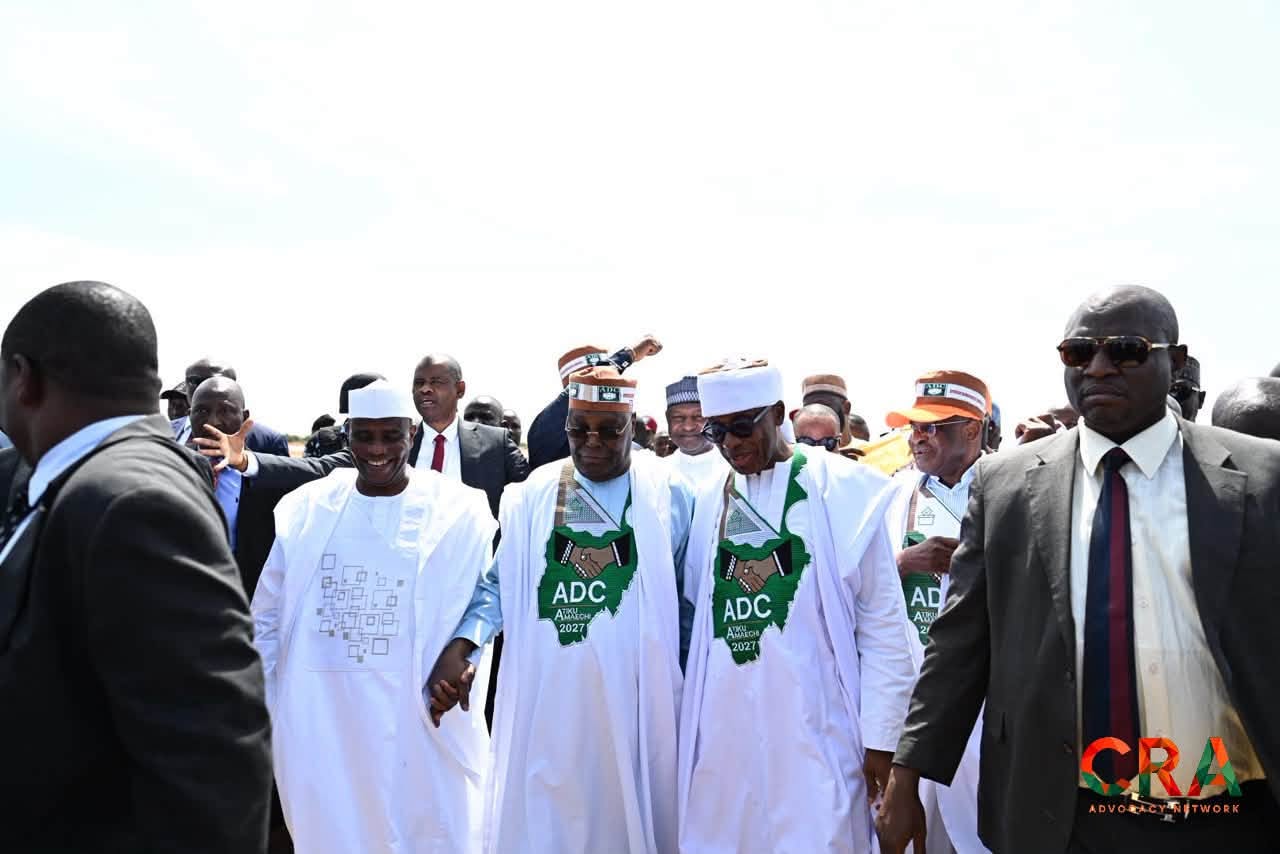
The African Democratic Congress (ADC) has described the turnout at Atiku Abubakar’s presidential campaign launch in Sokoto on Wednesday as a statement of rejection of the economic hardship facing Nigerians, while the Emir of Kano, Muhammadu Sanusi II, has credited President Bola Tinubu with stabilising the economy.
Join the Premium Times WhatsApp Community For Quick Access To News and Happenings Around You.
Open in WhatsApp
Mr Sanusi, speaking at an Oxford conference on Tuesday, praised improvements in economic growth, inflation and foreign reserves but acknowledged that Nigeria still faced significant challenges.
His remarks, circulated on Wednesday by presidential spokesperson Sunday Dare, came as Atiku’s campaign sought to make the cost of food, fuel and transport a major issue in the 2027 presidential election.
The separate interventions highlighted a question facing the Tinubu administration: how far improvements in economic indicators have translated into relief for households.
ADC celebrates Sokoto turnout
In a statement issued on Wednesday, the ADC Presidential Campaign Council said residents lined the route from Sultan Muhammad III International Airport to the party’s state secretariat to welcome Atiku, delaying his motorcade for three and a half hours.
The council claimed that commercial activities stopped in parts of Sokoto as residents joined the procession.
It described the turnout as spontaneous and rejected suggestions that participants had been mobilised through financial inducements.
Stay Ahead with Premium Times
Follow us on Google News and never miss breaking stories, investigations, and in-depth reporting.
Add as a preferred source on Google
“When you have a message that connects with the people, you do not need to rent a crowd. The people show up on their own,” said Phrank Shaibu, the council’s director of strategic communication.
The campaign’s account of the motorcade’s duration and the disruption of commercial activities has not been independently verified.
Sokoto is governed by the All Progressives Congress (APC), and Wednesday’s launch marked the beginning of Mr Atiku’s presidential campaign in a state controlled by the ruling party.
Campaign launch follows dispute over facilities
The ADC also accused the Sokoto State Government of denying it access to public facilities requested for the campaign launch and obstructing its preparations.
The council claimed the restrictions had encouraged more residents to attend the event.
The allegation followed the state government’s decision to seal a building the ADC used on Ahmadu Bello Way.
As PREMIUM TIMES previously reported, the Commissioner for Lands and Housing, Nasiru Dantsoho, said government records identified the defunct Savannah Bank as the property’s owner, with no documented transfer of ownership.
He said the government had asked the Nigeria Deposit Insurance Corporation (NDIC) to clarify ownership and ordered the premises sealed, citing security concerns.
Mr Shaibu acknowledged Savannah Bank’s ownership but questioned the government’s authority to close the building. He told PREMIUM TIMES that political parties had occupied the premises for about two decades, most recently the Peoples Democratic Party (PDP).
He also said he visited the property on Tuesday morning and encountered no physical restriction.
The disputed building had not been established as the intended venue for Wednesday’s campaign launch.
The ADC’s latest statement did not identify the other public facilities allegedly denied to the party or provide details of the requests.
The dispute also followed Atiku’s allegation on Tuesday that the State Security Service (SSS) was recruiting protesters to cause disturbances in Sokoto and give the state government grounds to impose a curfew.
The SSS rejected the allegation and said its director-general had ordered an investigation.
The agency cited its protection of the ADC governorship candidate in Sokoto, Manir Dan’iya, during an attack it dated to 31 October. It said two operatives were injured while evacuating him.
The SSS account did not directly establish whether any of its personnel had been involved in the alleged mobilisation of protesters.
Atiku proposes subsidy for locally refined fuel
At Wednesday’s rally, Atiku renewed his campaign’s promise to reduce living costs through a targeted subsidy for qualifying petroleum products refined in Nigeria.
According to the ADC Presidential Campaign Council, the proposed production-based subsidy would support domestic refining and reduce fuel costs, with benefits expected to extend to transport, food prices and household expenses.
The proposal differs from the previous fuel subsidy arrangement, which involved government support for petrol consumption regardless of whether the product was refined locally or imported.
However, the campaign has yet to explain the proposed subsidy rate, how eligible refiners and products would be selected, how the scheme would be financed or how lower production costs would translate into lower retail prices.
These questions matter because Nigeria’s previous fuel subsidy system imposed substantial costs on public finances.
Petrol prices rose sharply after Mr Tinubu announced the removal of the subsidy in May 2023. Changes to the foreign-exchange system also increased the naira cost of imported goods and production inputs.
Although inflation has since slowed, the higher prices accumulated over the intervening years continue to affect household spending.
Sanusi credits Tinubu with economic progress
At the Oxford Global Think Tank conference convened by former Securities and Exchange Commission Director-General Arunma Oteh on Tuesday, Mr Sanusi said Nigeria had made progress towards economic stability under Mr Tinubu.
The former Central Bank of Nigeria governor cited improvements in economic growth, declining inflation and external reserves as evidence that the administration’s reforms were producing results.
He said the economy grew by 4.48 per cent in the second quarter of 2026, compared with what he described as average growth of 0.9 per cent during the administration of former President Muhammadu Buhari.
However, official figures put second-quarter growth at 4.43 per cent, up from 3.89 per cent in the first quarter.
Mr Sanusi also pointed to the decline in headline inflation from above 30 per cent to about 14.6 per cent, projecting 12.5 per cent by the end of 2026.
According to the National Bureau of Statistics figures reported by Reuters, headline inflation fell to 14.63 per cent in September from 15.39 per cent in August.
The emir further claimed that Nigeria’s dollar-denominated gross domestic product per capita had risen by 47 per cent since 2023.
He put external reserves at $55 billion but cautioned that part of the increase was driven by foreign portfolio investments, which could leave the country exposed to sudden withdrawals.
Mr Sanusi attributed some of the inflows to higher global oil prices and attractive returns on Nigerian investments.
He also said the Dangote Refinery accounted for approximately 20 per cent of Nigeria’s exports, citing the refinery’s contribution to economic diversification.
The figures he gave for dollar-denominated GDP per capita and the refinery’s share of exports have not been independently verified against the relevant official datasets.
“I’m not a fan of politicians, but we need to give credit to President Tinubu’s administration for bringing us back from the brink,” Mr Sanusi said, according to TheCable.
He described the improvements as the beginning of economic stability rather than the completion of the country’s recovery.
“There are clearly foundations being laid for stability. It’s not the end, but the first step towards stability,” he said.
Mr Sanusi also criticised the administration’s handling of public criticism, accusing it of treating suggestions and contributions it disagreed with as attacks.
“This government doesn’t express itself properly. It sees every suggestion and contribution it does not like as an attack, and it doesn’t have good spokespersons,” he said.
Why falling inflation has not ended hardship
Improvements in Nigeria’s economic indicators have not brought a corresponding reduction in the prices of essential goods.
A decline in inflation from more than 30 per cent to 14.63 per cent means that prices are generally rising more slowly, not that they have returned to their previous levels.
Food inflation remained higher than headline inflation at 19.59 per cent in September, according to the NBS.
Economic growth also measures changes in the value of goods and services produced, rather than directly showing whether individual households can afford more food, fuel or other necessities.
These differences help explain why Atiku can campaign on the hardship facing Nigerians even as Mr Sanusi acknowledges progress in economic growth and inflation.
The Tinubu administration has defended its reforms as necessary to correct longstanding economic problems, including the fiscal burden of fuel subsidies and distortions in the foreign-exchange market.
Atiku’s campaign, however, argues that Nigerians need more immediate relief from the cost of essential goods.
Whether the improvements in growth and inflation will translate into stronger purchasing power remains an important question as the country approaches the 2027 presidential election.
to like, bookmark, and comment.
Comments
Join the conversation:
No comments yet. Be the first to share your thoughts.