NSCIA Holds Special Prayers for Nigeria at 66, General Assembly Set for Thursday
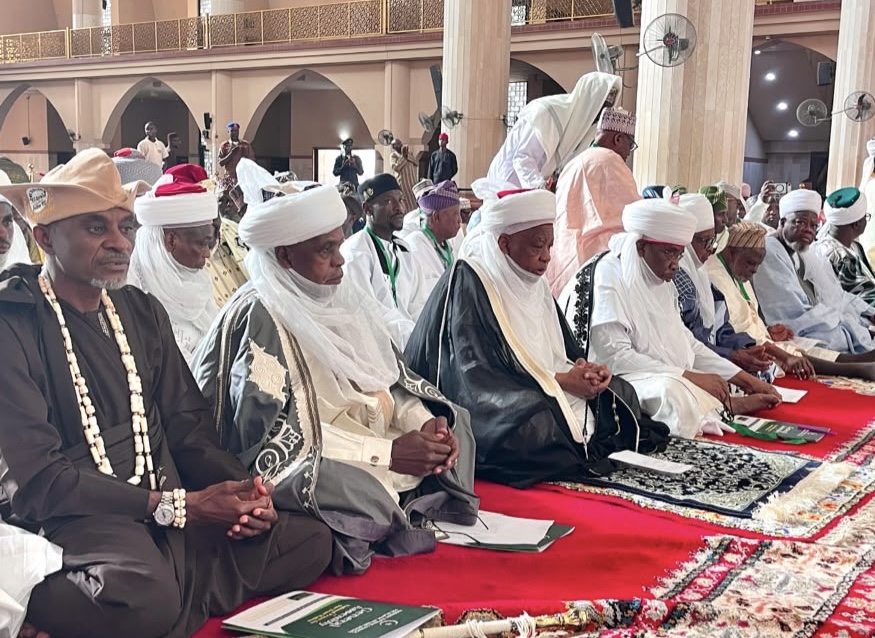
A special prayer session for peace, security and stability in Nigeria has been held by Muslim and traditional leaders as the country observes its 66th Independence Anniversary.
The Nigerian Supreme Council for Islamic Affairs (NSCIA) organised the programme, which took place on Wednesday at the National Mosque Complex in Abuja under the leadership of its President-General and Sultan of Sokoto, Alhaji Muhammad Sa'ad Abubakar.
Islamic scholars, imams, traditional rulers and Muslim representatives drawn from different parts of the country attended the gathering, where insecurity, poverty, hunger and economic difficulties dominated both the prayers and the discussions.
In a welcome address, NSCIA Secretary-General Professor Is-haq Olanrewaju Oloyede described the programme as part of the Council's duty to national development and said it offered a chance to pray for Nigeria, its leaders and the religious community.
Oloyede, however, stressed that supplication must go hand in hand with a stronger relationship with Allah, calling on Muslims to deepen their connection with their Creator and to fulfil their obligations to the nation.
"We owe it a duty, a religious duty indeed, to pray for Nigeria," he said.
He observed that the country's many languages do not prevent collective prayer, noting that although Arabic is required for certain canonical acts of worship, individuals may offer personal supplications in whichever language allows them to express themselves best.
After the national prayer, Sheikh Professor Khalid Aliyu Abubakar delivered a lecture titled "The Importance of Nation-Building and the Values of Prayers."
Sheikh Khalid said building a nation demands the active involvement of citizens and institutions, and he urged Nigerians not to stay aloof from the problems facing the country.
Referring to Islamic teachings and Prophet Ibrahim's prayer for the security and wellbeing of a community, he asked Nigerians to make positive contributions to their communities and to the wider society.
He further called on religious leaders to steer Muslims towards constructive participation in national development while continuing to pray for peace, security, economic prosperity and the wellbeing of families and communities.
The Olowu of Owu Kingdom, Oba (Professor) Saka Adelola Matemilola, said traditional rulers occupy a vital position in sustaining peace because of their close ties to communities and the respect they enjoy.
The monarch advised traditional rulers to stay non-partisan, especially when political tensions run high, saying their influence should be used to promote balance and to stop disagreements from degenerating into conflict.
He also named poverty and economic deprivation as conditions that can fuel insecurity and social problems, and urged traditional rulers to collaborate with political leaders and communities to tackle them.
Oba Matemilola further charged the coming generation of Islamic scholars to pair religious knowledge with good character and exemplary conduct.
At the National Mosque, Imam Eze Haroun said the gathering was an opportunity to commit Nigeria and its people to Allah and to seek divine intervention in the country's difficulties.
"We are praying that Allah subhanahu wa ta'ala should come in and take control and bring back peace, bring back stability, bring back development to our nation," he said.
He also emphasised the need for guidance and sincerity among Nigeria's leaders, and noted the significance of Islamic and traditional leaders from various parts of the country coming together.
The special prayer formed the first part of a two-day NSCIA programme at the National Mosque Complex.
The Council's General Assembly, described as its highest decision-making organ, is scheduled for Thursday, October 1, at the same venue.
The Assembly is expected to draw members of the Council, representatives of State Councils for Islamic Affairs and Islamic organisations, Muslim public office holders and other prominent Muslim personalities for consultations on matters affecting the Muslim community and the country.
to like, bookmark, and comment.
Comments
Join the conversation:
No comments yet. Be the first to share your thoughts.