Jigawa Shifts Focus from Buying Tractors to Building a Mechanisation System
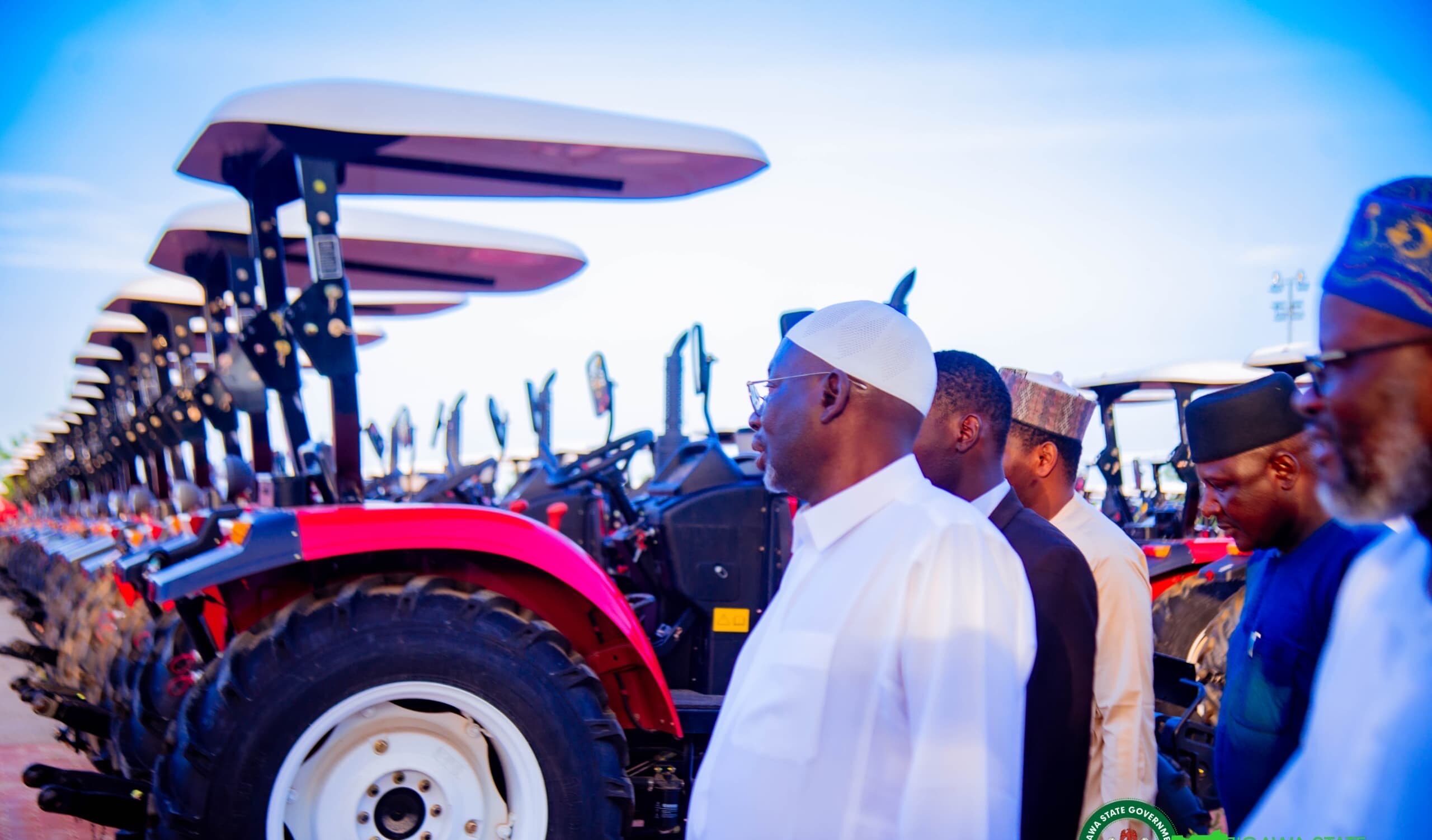
For years, agricultural mechanisation in Nigeria has followed a predictable and often disappointing script. A government announces the purchase of tractors, commits large sums of public money, unveils the equipment with much ceremony — and the smallholder farmer is still left tilling the soil with a hoe and a cutlass.
The difficulty has rarely been a simple shortage of tractors. What has been missing is a workable arrangement for keeping those machines in productive use.
A tractor sitting idle in a government yard tills no land. Without fuel, a trained operator, spare parts and regular servicing, it is merely costly scrap. And if a farmer cannot reach a tractor at the moment it is needed, the machine cannot deliver the transformation it was bought for.
That is the context in which Jigawa State's emerging mechanisation strategy is worth examining. Under Governor Umar Namadi, the focus appears to be moving away from the old question of how many tractors the government can purchase, towards a different one: how can a system be built that guarantees farmers access to mechanisation whenever they require it?
The approach includes setting up mechanisation service centres across the state, investing in tractors and harvesters, deploying agricultural extension workers, training technical staff, using digital monitoring, and bringing machinery closer to farming communities. Taken together, these steps point to an effort to construct an agricultural ecosystem rather than simply hand out equipment. Whether the investment becomes another entry in Nigeria's record of underused farm machinery, or the start of something that genuinely changes farming, may hinge on that distinction.
For a long time, tractor programmes nationwide have run along familiar lines. A government buys machines, and they are allocated to farmers, cooperatives or agencies. Questions about utilisation, maintenance and accountability then begin to surface. Some equipment becomes unserviceable through poor upkeep. Some is hard to deploy because of fuel and running costs. In other cases, the machinery is simply unavailable to the farmers who need it during planting and harvesting. The outcome is that huge public spending can fail to produce a matching rise in agricultural output.
This is why Jigawa's model should be judged not only by the number of machines acquired but by the institutional arrangements built around them.
One of the most significant elements is the creation of the Jigawa State Farm Mechanisation Service Company. The thinking behind it is simple: farmers do not have to own tractors to gain from mechanisation. What they need is dependable and affordable access to tractor services. That matters especially in Jigawa, where most farmers are smallholders.
It would be unrealistic to expect an individual smallholder to buy a tractor, maintain it, hire a trained operator and cover the cost of spare parts and repairs. A well-run mechanisation service addresses that gap. Rather than every farmer owning a machine, the government or a professionally managed company can run a fleet and offer land preparation, planting, spraying and harvesting services. A single tractor can then serve many farmers in one season — the same principle that underpins commercial equipment-hiring systems elsewhere in the world.
The reported establishment of 60 mechanisation service centres across Jigawa's 30 constituencies is also important. Machinery has to be close enough to farming communities to be useful. A farmer cannot wait weeks for a tractor once the rains have begun; timing is critical in agriculture. Planting late can cut yields, and failing to harvest on time can cause serious losses. Mechanisation therefore matters not only because it eases physical labour but because it allows operations to be carried out within the right window, with a direct effect on productivity.
Yet the tractor is only a starting point. It would be a mistake to assume that agricultural transformation ends with procurement. A tractor is one part of a much wider system. Farmers also need improved seeds, fertiliser, irrigation, extension services, crop protection, storage, processing facilities, transport and market access. A farmer with a tractor but no good seeds may still harvest little. A farmer with a bumper harvest but no storage may see post-harvest losses eat into his income. A farmer who grows more food but cannot reach profitable markets may find that higher output does not improve his livelihood. Mechanisation, in other words, has to be woven into the broader agricultural value chain.
One encouraging part of the strategy is the attention given to extension services. Extension workers act as the link between scientific knowledge and the farmer, advising on improved varieties, planting methods, fertiliser use, pest and disease control, soil management and other practices that raise productivity. The reported provision of motorcycles for these workers is more than a logistical detail. It can reshape how the extension officer relates to rural farmers. With reliable transport, an officer can visit more farms, monitor crops more closely and respond faster when problems arise. That is particularly valuable as mechanisation is introduced, since farmers need to understand how to combine machine operations with better agronomic practices.
There is also room to strengthen the programme through farmer cooperatives and farm clustering. Mechanisation tends to work better when larger areas are cultivated together, instead of tractors moving constantly between many small, fragmented plots. Government can encourage farmers to form strong and transparent cooperative societies. Farmers need not give up ownership of their individual farms; they can instead coordinate their production schedules and arrange their land into contiguous clusters that let machinery operate more efficiently — as when a tractor enters a 200-hectare cluster and prepares the land systematically.
to like, bookmark, and comment.
Comments
Join the conversation:
No comments yet. Be the first to share your thoughts.