Nasarawa At 30: How A One-Road State Became A Mining Hub – Jega, Kukah
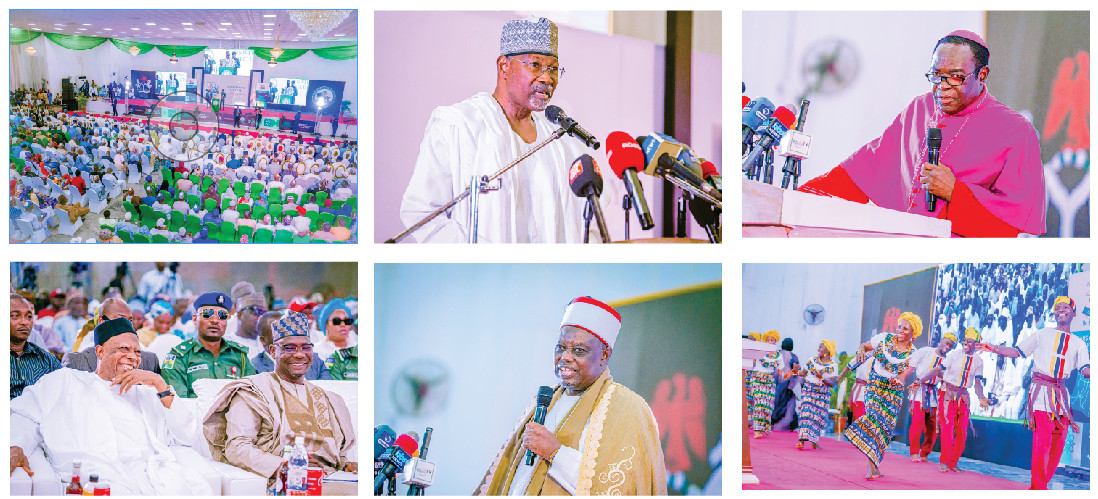
When Nasarawa State was carved out of old Plateau State on October 1, 1996, it had, in the words of Prof. Attahiru Jega, “one tarred road, no water board and no secretariat.” Thirty years later, in a banquet hall in Lafia, that same state was being described as Nigeria’s heart — geographically, demographically and economically.
The occasion was a public lecture to mark Nasarawa at 30, held on October 30, with two erudite scholars — Jega and Bishop Matthew Hassan Kukah — as speakers.
The lecture brought together all personalities who have held sway in the state, except the late Aliyu Akwe Doma. Jega, Kukah and Governor Abdullahi Sule used data and empirical evidence to show how a predominantly rural state became what Sule now calls “a living legacy” of its founding fathers.
Sule’s Transformative Strides Through Jega’s Numbers
Former INEC Chairman Prof. Attahiru Jega, speaking as Pro-Chancellor of Nasarawa State University, Keffi, said he was speaking from what he “knows best.” In his paper titled “Nasarawa State at 30: From Foundation to Transformation,” he told a stark story of how the state started as one of Nigeria’s most rural, heavily dependent on Federation Account Allocation. Internally Generated Revenue contributed only 3.7 percent to the budget in 1997. Today, he said, it contributes at least 11 percent.
The most visible sign, he argued, is roads. The state now has 1,500 kilometres of tarred roads in total. Of that, 639 kilometres were built in the last seven years by the Sule administration.
It is, Jega said, a shift from “conservative development to aggressive urban renewal.” The figure has become a signature of the administration — 639km of road networks cutting across the three senatorial zones, with bridges, culverts and drainage systems.
But he insisted roads alone do not make transformation. He tied the IGR growth to a deliberate pivot Sule made in 2019: stop running Nasarawa as a civil service state and run it as a mining and industrial state.
Through the Nasarawa Economic Development Strategy and NASIDA, the state’s investment agency, two lithium processing plants — Avatar New Energy Materials and New Diamond Energy — have been facilitated, with a combined capacity of 9,000 metric tons per annum.
However, as an academic of international repute, analysts argued that Sule’s legacy in education was the erudite professor’s emotional core as he reeled out comparative data from 1996 to 2026.
According to him, the number of public primary schools has increased from 1,402 to over 2,100. Secondary schools from 100-150 to 490, with 418 functional and 30 under construction. The number of tertiary institutions from 2 with 2,500 students to 18 with over 60,000 students respectively.
At NSUK, he said, the result is already visible in teaching quality and research. Female enrolment — his key human capital indicator — jumped from 68,000-78,000 girls in 1996 [22% of school-age girls] to 333,000-343,000 in 2026 [44%], an increase of over 371 percent.
“I have followed his vision for human capital development. Investment in education has a long gestation period and requires sustained attention. Whoever thinks education is expensive should try ignorance,” he said.
Other indicators followed the same arc: poverty rate from 70 percent to 62 percent, pipe-borne water coverage from 5-8 percent to 29 percent in urban areas, Physical Quality of Life Index from 40-45 percent to 67 percent, maternal mortality from 1,100 to 340 per 100,000 births.
His verdict was categorical: “I can say without fear of contradiction that the record of achievements of Governor Engineer Abdullahi A. Sule in the past seven years are indeed transformational.”
Kukah’s Question on Unity
After Jega’s analysis, Bishop Kukah weighed in with his paper titled “Unity in Diversity: Three Decades of Building a Cohesive Nasarawa State.” He opened with a question that reframed Jega’s data: “After Professor Jega has assembled the empirical data of progress undertaken by successive governors, now that all of this goodwill has been generated, how do we effectively and efficiently distribute it in a way that does not renew volatility but guarantees stability?”
Nasarawa, he said, is Nigeria in miniature. Over 30 ethnic groups — Tiv, Fulani, Jukun, Hausa, Idoma, Eggon, plus indigenous Alago, Mada, Wandra, Bassa — scattered across 13 local government areas.
“Africa often sees multiplicity as a problem, while America, where hardly any nationality is not represented, turned it to greatness by anchoring citizenship rights in the constitution.”
His most quoted metaphor was geographic. “Take a look at the map of Nigeria. When you stand at that roundabout in Akwanga, that is one of the most strategic locations in Nigeria. From that roundabout, you can continue your journey all the way to Kano, to Maiduguri, to Abuja and beyond, to Calabar and to Uyo. No state has that kind of location.”
If Nigeria were a human being, he said, Nasarawa would be its heart. That location, plus endowments — Farin Ruwa Waterfalls in Wamba where the state plans 20MW hydro, Hunki Oxbow Lake in Awe, Peperuwa Lake in Doma, 60 small lakes and rivers, vast solid minerals, and Dangote’s presence — could make Nasarawa “a favourite destination for agriculture and tourism, but this has to be by deliberate policy.”
He cautioned that infrastructure alone cannot make the state great. “It is no use for the state to progress if the people themselves are not progressing,” he said. A child in Wamba, Doma or Awe, he argued, will understand belonging not through speeches but “through a scholarship, a good road, a functioning school, and through a special unity programme.”
He praised Sule for bringing former governors together on one stage — Adamu, Mande, Al-Makura — saying “Nigeria is the only country averse to learning from predecessors.”
And unity, he said, grows by metaphors. If Nasarawa United fields a Tiv striker and he scores, “all the anxiety you may have about Tiv people will go out of the window.”
His final plea was blunt: “Please do not wait for ordinary people to come and kneel down and beg government to do road for their village.”
Sule’s Response
Governor Abdullahi Sule used the twin celebration of Nigeria’s 66th Independence and Nasarawa’s 30th anniversary at Lafia City Square to elaborate on the progress.
He traced agitation to 1980 during the Second Republic alongside the Middle Belt movement, until General Sani Abacha created six states including Nasarawa on October 1, 1996.
He paid tribute to the first Military Administrator, late Wing Commander Abdullahi Ibrahim, and his successor Colonel Bala Mohammed Mande, plus democratic predecessors Senator Abdullahi Adamu, late Alhaji Aliyu Akwe Doma, and Senator Umaru Tanko Al-Makura.
“Our diversity is a reality. It should never become a source of division,” he said. “The task before us is to build a Nasarawa where no community is considered inferior or superior.”
On security, he listed Super Camps at Kenyehu and Udege, Forward Operating Base in Doma, Police Mobile Training College at Ende Hills, and Air Force Special Forces Base in Lafia. He announced that from the expansion of the Nigerian Army from 8 to 12 divisions, Nasarawa secured 10 Brigade with three battalions and one artillery regiment — Brigade HQ in Shabu, battalions in Wamba, Awe and Toto, artillery in Nasarawa LGA.
On workers, he announced 100% gratuity arrears from 1996-2012 cleared, 2013 being concluded, salaries and pensions stabilized, and a new integrated secretariat housing all MDAs.
Beyond the 639km, he listed three flyovers — Lafia, Keffi and Mararaba — the first in state history, plus rural roads across 13 LGAs, Yahaya Sabo and Muhammadu Buhari bus terminals in Lafia and Karu, and modern markets in Keffi, Akwanga, Nasarawa Eggon and Doma commissioned, with Awe and Wamba ready.
He closed on health, agriculture and youth: free medical outreaches, Dalhatu Araf Specialist Hospital handed to Federal University of Lafia as Teaching Hospital, mega farms in Jangwa and Agwatashi, and vocational institutes in Lafia and Doma.
to like, bookmark, and comment.
Comments
Join the conversation:
No comments yet. Be the first to share your thoughts.