Nigeria @66: The Sovereign’s Scalpel And The Unfed Patient
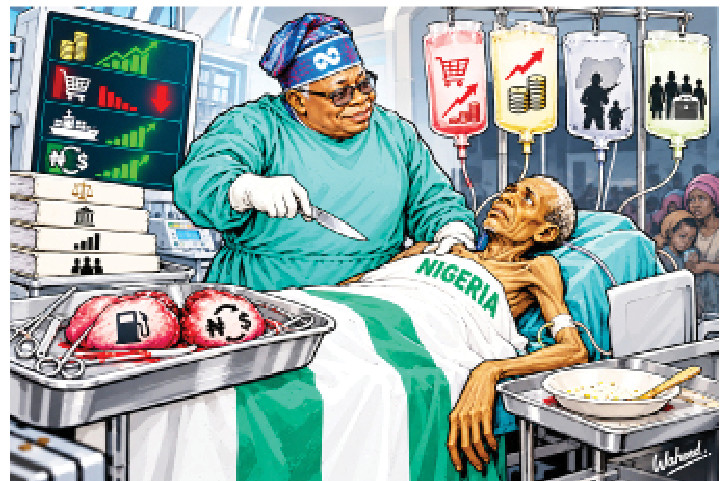
In his treatise On the Governance of Rulers, Thomas Aquinas observed that the true measure of a king’s wisdom is found not in the magnificence of his decrees, but in whether his people can eat the bread of their own labour in peace and dignity. Listening to President Bola Ahmed Tinubu deliver his Independence Day address on October 1, 2026, one was struck by the stark, uncomfortable chasm between official executive satisfaction and widespread public exhaustion.
The address was an undeniably fluent piece of statecraft, delivered with the serene confidence of a leader convinced that his severe macroeconomic interventions have finally stabilized the ship of state. Yet, strip away the elevated cadence, and one finds an address that speaks to a balance sheet rather than a society – a cold, analytical post-mortem that celebrates the repair of public finances while asking millions of citizens to remain patient on an empty stomach.
A hard-nosed analyst must give the President his due where empirical facts support his narrative. The administration deserves genuine credit for confronting severe structural distortions long evaded by successive governments. The removal of the petrol subsidy and the unification of chaotic foreign exchange windows were necessary, if extraordinarily painful, surgeries. The administration’s fiscal discipline has indeed yielded measurable macroeconomic results. Gross official foreign reserves have crossed the $54 billion threshold, headline inflation has finally decelerated from its terrifying 34 percent peak down to 15.39 percent, and non-oil export earnings exceeded $6 billion in 2025. These verifiable figures demonstrate that federal revenues have expanded and that the state’s balance sheet has been stabilized.
The Arithmetic of Decelerating Impoverishment
Yet, as Joseph Schumpeter warned in his foundational writings on economic development, aggregate statistics isolated from human welfare can easily become an academic sedative. The President’s assertion that the national foundation has been repaired and that we are transitioning into an age of widespread prosperity relies on a classic statistical illusion. According to the National Bureau of Statistics, headline inflation dropped to 15.39 percent in August 2026. In economic history, this represents the classic tragedy of the aggregate: when inflation decelerates, prices do not fall; they simply climb the wall at a slightly less vertical angle.
The ordinary Nigerian purchasing garri, rice, or yam in local markets does not experience a comforting statistical curve. Instead, they bear the compounding, unyielding weight of a 300 percent cumulative price surge over the last thirty-six months. Celebrating a decelerating rate of price increases as the dawn of prosperity is akin to praising a fire brigade for slowing down the burn rate of a house while the roof continues to collapse on its occupants. The sovereign balance sheet may look far healthier to multilateral lenders in Washington, but for the average household, the daily cost of basic survival remains agonizingly high.
Capital Swaps and the Debt Burden
The speech took an explicit victory lap over foreign exchange stability and rising foreign reserves, noting that international observers, rating agencies, and private investors have recognized Nigeria’s macroeconomic resilience. The official exchange rate has indeed stabilized around N1,500 to the US dollar. However, a balanced political economy interrogation must ask a fundamental question: at what structural cost was this equilibrium bought? As David Ricardo demonstrated in his classical trade and capital analyses, international capital flows respond strictly to real yields and debt security, not patriotic rhetoric.
The stabilization of the Naira was bought primarily through aggressive monetary tightening by the Central Bank of Nigeria, raising benchmark interest rates to record highs and severely choking domestic small and medium enterprises. Furthermore, figures from the Debt Management Office show that total public debt surged to N166.79 trillion ($120.93 billion) by mid-2026, with external debt obligations expanding by over $11 billion under this administration. We have not eliminated our structural dependence; we have merely swapped an unbudgeted domestic fuel subsidy for heavy international capital market debt servicing. Portfolio investors are enjoying high yields on short-term government paper, while greenfield foreign direct investment into real physical manufacturing capacity remains stubbornly timid.
Agrarian Bottlenecks and Transaction Costs
The President’s formula for lowering the cost-of-living centers heavily on mechanization, dry-season farming, expanded irrigation, and improved transport networks to connect rural farms directly to urban markets. He argued logically that reducing post-harvest losses and transport bottlenecks will naturally drive down market prices. Yet, this textbook supply-side approach ignores the institutional realities outlined by Douglass North regarding transaction costs and governance failures in developing economies.
You cannot execute a low-cost agricultural revolution in a country where primary farming belts remain high-risk security zones. In the Middle Belt and North-West, agricultural output is restricted not merely by a lack of seeds or access to fertilizer, but by persistent physical insecurity. When farmers must pay illegal “harvest taxes” to non-state armed actors just to access their own cassava plots, no amount of road construction will magically lower market prices. The proliferation of extortionate security checkpoints, logistics cartels, and elevated diesel costs act as a permanent, unregulated tax on every agricultural commodity moving across state borders. The President’s supply chain logic is sound on paper, but it breaks down completely on the road to the market.
Financialised Palliatives as Social Policy
To address immediate public hardship, the speech highlighted social safety nets, including the Nigerian Education Loan Fund (NELFUND) and the Consumer Credit Corporation (CREDICORP). The President presented these measures as vital bridges toward long-term opportunity. However, as Karl Polanyi observed in The Great Transformation, introducing consumer credit systems into deeply impoverished societies often turns systemic economic failure into individual debt burdens.
Providing consumer credit for vehicles or solar systems to urban workers whose real wages have lost over 60 percent of their purchasing power is not an economic growth strategy; it is a financialization of survival. Pushing consumer debt onto a struggling population risk creating long-term default cycles in an unstable labour market. Similarly, targeted cash transfers managed through a national social register serve as temporary cushions rather than permanent ladders out of poverty. Distributing minor stipends to vulnerable households while macro-level purchasing power continues to erode does not eliminate poverty; it merely manages human deprivation with greater administrative efficiency.
The Mirage of Executive Proclamations
The President concluded his address with a soaring call to faith, declaring that the nation has passed through its own Red Sea and that the age of reform has given way to the age of prosperity. But as Alexis de Tocqueville observed during his studies of political transitions, the most dangerous moment for a government is when it attempts to reform itself without providing immediate, felt relief to those bearing the burden of those reforms.
Prosperity cannot be established by executive decree, nor can it be validated solely through praise from foreign institutions. A nation cannot claim its foundations are fully repaired when the human capital required to build upon them continues to emigrate in search of basic stability. The administration has proven beyond doubt that it possesses the political will to perform drastic economic surgery and rebalance state accounts. What it has yet to demonstrate, empirically or practically, is whether it can keep the patient nourished, productive, and alive once the operating table is cleared.
to like, bookmark, and comment.
Comments
Join the conversation:
No comments yet. Be the first to share your thoughts.