In A Year, Coca-Cola’s Billion-Dollar Investments And Initiatives Power Nigeria’s Impact Value Chain
For so long, conversations about investment in Nigeria have often centred on foreign capital, infrastructure projects and government interventions. Yet, beneath those headline-grabbing developments lies a vast network of businesses, suppliers and service providers whose economic contributions quietly sustain livelihoods across the country.
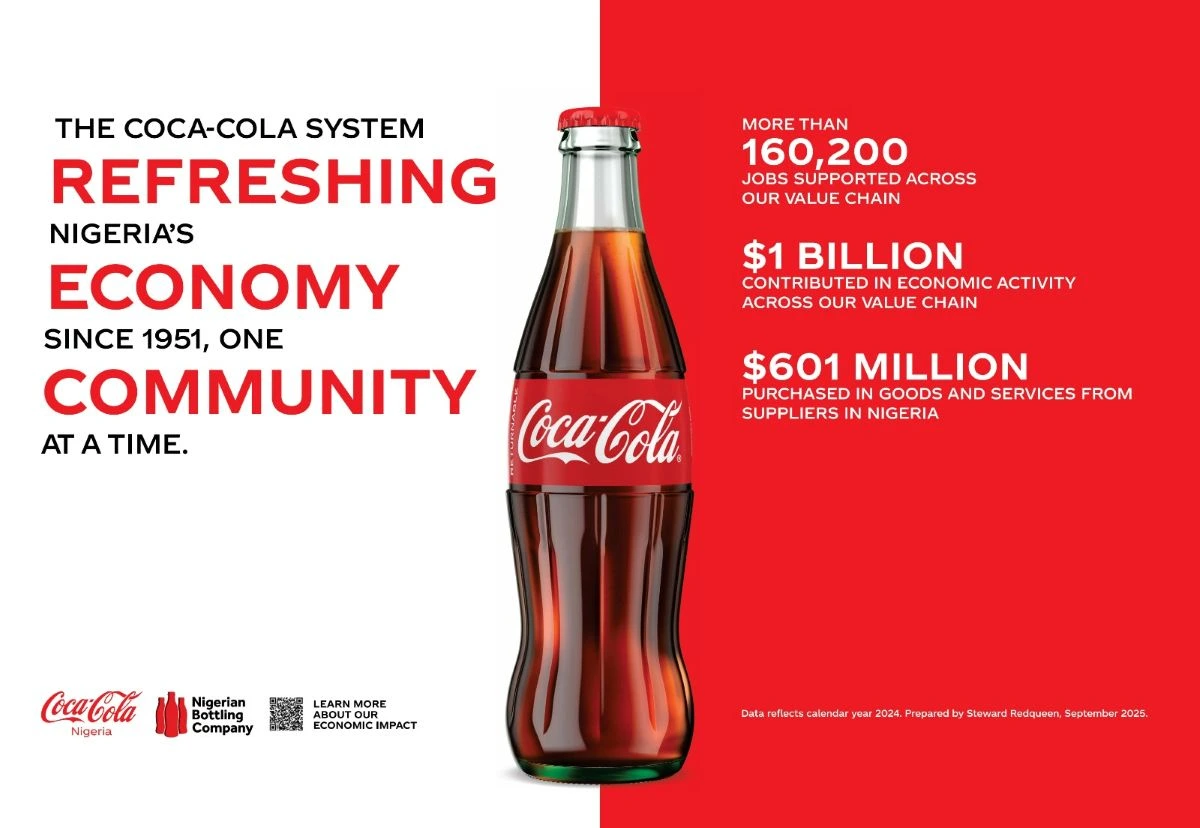
A Socio-Economic Impact Assessment conducted by global consultancy Steward Redqueen has shed fresh light on how the Coca-Cola System in Nigeria, comprising The Coca-Cola Company and its authorised bottling partner, the Nigeria Bottling Company (NBC), is contributing to that ecosystem, revealing a value chain that generated an estimated $1 billion in economic activity in Nigeria in 2024.
Using Nobel laureate Wassily Leontief’s input-output model, the study offers a comprehensive analysis of the system’s footprint across the country in the year under review. The findings paint a picture of a business that extends far beyond beverages. Through a network of manufacturers, distributors, wholesalers, retailers and suppliers, the Coca-Cola System has become deeply intertwined with Nigeria’s economic landscape.
Decisive Job Creation and Enterprise Empowerment
The $1 billion figure represents value-added economic activity generated across the value chain in the period under review: the sum of the salaries, taxes and profits that contribute to the gross domestic product (GDP).
The employment numbers tell the story most vividly. The system directly employed 2,989 people in 2024. Beyond its own payroll, it supported 157,200 indirect jobs across retail, agriculture, manufacturing, transport and services, bringing the total to roughly 160,200 jobs supported in the year under review.
Put simply, for every job directly created within the Coca-Cola System, it supported an additional 53 jobs across the broader value chain. This illustrates how economic activity generated by one joint System can ripple across multiple sectors of the economy.
Buying Nigerian And The Multiplier Effect
At the heart of the assessment’s findings on the System’s operation is local enterprise. From the sugar farmers and suppliers that support production to truck operators moving products across the country and small retailers serving the consumers, thousands of Nigerian businesses are connected to the System’s operations.
The study found that the system purchased $601 million worth of goods and services from suppliers in Nigeria in 2024. Ingredients and packaging are mostly sourced, supplied, produced and distributed in-country, a model the System says deliberately keeps value in the country. This reinforces the role of local sourcing and domestic enterprise development in driving economic growth.
The report goes beyond direct factory operations to measure and track the upstream and downstream ripple effects of the System’s operations in the country: agricultural suppliers providing raw material, a packaging producer serving a bottler or can and also buys raw materials (upstream); the retailers, restaurants and the businesses that serve the finished products to the final consumer (downstream).
By tracing these upstream and downstream relationships, the assessment captures activity that would be missed by examining the manufacturer alone.
Steward Redqueen, which has run similar studies for the Coca-Cola System in more than 60 markets, combined operational data, collected under strict non-disclosure agreements, alongside data obtained from sources, including the World Bank, the International Labour Organisation, Purdue University’s Global Trade Analysis Project and Euromonitor, to quantify the full scope of the system’s economic multiplier.
Sustainability at the Core of Operations
The assessment also points to the System’s increasing focus on sustainability and community development. In 2025, the Coca-Cola System in Nigeria opened a new packaging collection hub in Apapa, Lagos, which can process up to 13,000 metric tonnes of plastic bottles annually. The facility expands local recycling infrastructure, mitigates urban plastic waste, and advances a circular economy while creating green jobs.
Water stewardship is another key area of investment. The wider Coca-Cola System has announced plans to invest nearly $25 million by 2030 across 20 African markets, including Nigeria, to address critical water-related challenges, improve access to water and sanitation services, and help protect important watersheds.
Foundation For Future Growth
Looking ahead, the Coca-Cola System has signalled its intention to accelerate investment in Nigeria, with plans to reach $1 billion in investments over the next five years, subject to the availability of a predictable and enabling business environment.
Taken together, the assessment shows how sustained investment, local sourcing, job creation and sustainability initiatives by a company can combine to create meaningful value and impact. The numbers are not merely statistics. They are livelihoods, opportunities and evidence that economic growth often begins in communities long before it is reflected in national accounts, and anchoring industrial sustainability at a time when it is most needed.
to like, bookmark, and comment.
Comments
Join the conversation:
No comments yet. Be the first to share your thoughts.